
Yin Yoga Teacher Training Online
Online via Zoom
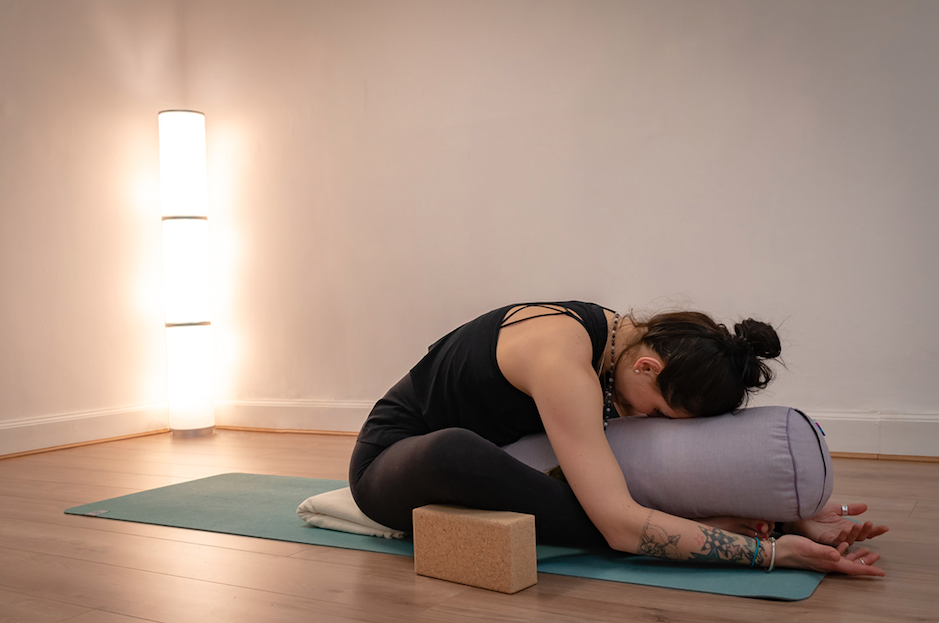
About this training…
In this comprehensive Yin Yoga Teacher Training we will practice Yin Yoga postures according to season & first hand feel the effects of unblocking our energy lines.
You’ll learn about the science & purpose behind Yin Yoga and its roots in ancient Traditional Chinese Philosophy. This course will give you all the tools to confidently introduce Yin Yoga to your students in classes and sequence themed classes.
Yin Yoga offers us an opportunity to ‘clean house’ so that the body & its organs can function more harmoniously as laid out by the traditions of TCM.
All too often, the build-up of life stress, cause not only tightness and discomfort in the body, but deeper-rooted illness too. There is a way to undo the cycle and learn how to effectively relax, body, mind & soul. Yin can potentially aid healing by calming down the nervous system thus reducing stress & anxiety, improving health & wellbeing.
Please note: This course is open to all, whether you are already a yoga teacher or not.
The Training will cover:
1. Functional Anatomy & Fascia (The Deep Dive)
- Fascial Science: Moving beyond the “plastic wrap” analogy. Study the extracellular matrix (ECM), fibroblasts, and how mechanotransduction triggers tissue remodeling.
- Tensegrity: Understanding the body as a continuous tension network rather than a stack of bones.
- Compression vs. Tension: The cornerstone of functional Yin. Learning to identify when a student is limited by bone hitting bone (compression) versus tissues stretching (tension).
- Skeletal Variation: A lab-style exploration of hip sockets (anteversion/retroversion), femoral necks, and spinal morphology to prove why “alignment” is a myth in Yin. *
- The Science of “The Hold”: What happens to tendons, ligaments, and joint capsules during 3–5 minutes of stillness (creep and hysteresis).
2. Advanced Meridian Theory & The Subtle Body
- The 12 Primary Meridians: Deep dive into the internal pathways and their specific emotional/organ associations.
- Yin/Yang Organ Pairs: Detailed study of Zang-Fu theory (e.g., Kidney/Bladder) and how they manifest in physical and emotional health.
- Modern Meridian Theory: Exploring Dr. Hiroshi Motoyama’s research on water channels in connective tissue as the physical substrate for Qi.
- The Three Treasures: Understanding Jing (essence), Qi (energy), and Shen (spirit) within the context of a quiet practice.
3. The Functional Portfolio of Poses
- Target Areas vs. Aesthetic Shapes: Categorizing poses by “Target Areas” (e.g., Lateral Hip, Thigh, Spine) rather than names.
- The 7 Archetypal Yin Poses: In-depth breakdown of Shoelace, Saddle, Caterpillar, Dragonfly, Twist, Sphinx, and Square.
- Prop Artistry: Mastering the “Functional Prop” (using blocks, bolsters, and straps not just for comfort, but to change the load on target tissues).
- Wall Yin: A dedicated module on using the wall for accessibility, spinal decompression, and restorative variations.
4. Teaching Methodology & Sequencing
- The Art of Holding Space: The ethics of the teacher-student relationship in a vulnerable, quiet practice.
- Functional Cueing: Moving away from “put your foot here” toward “feel this sensation here.”
- Transitions & “The Rebound”: The physiological importance of the space between poses and how to guide students through the energetic “flush.”
- Advanced Sequencing:
- Sequencing for Anatomy (Target Areas).
- Sequencing for Meridians/Seasons.
- Sequencing for the Nervous System (The Vagus Nerve).
- The Language of Yin: Developing a “Yin Vocabulary”—using silence, poetry, and contemplative prompts without over-teaching.
5. Specialty Population & Clinical Application
- Yin for Modern Ailments: Specific protocols for chronic lower back pain, SI joint instability, and insomnia.
- Trauma-Informed Yin: Understanding how the stillness of Yin can trigger “thaw” responses in the nervous system and how to safely navigate them.
- The Aging Body: Focus on bone density (osteoporosis considerations) and maintaining joint lubrication (synovial fluid).
6. The Business & Ethics of Yin
- Marketing a Niche: How to communicate the value of “doing less” in a “more is more” fitness culture.
- Classroom Management: Dealing with “Yin Brain” (disorientation after long holds), temperature control, and sensory environment.
7. Yin vs. Restorative: The Science of Stillness
- Defining the “Why”: * Yin: A practice of “Positive Stress” (Hermetic stress) on connective tissues to increase mobility and tissue health.
- Restorative: A practice of “Zero Stress.” The goal is total support to elicit the Relaxation Response (Parasympathetic Nervous System dominance).
- The “Tension” Spectrum: * Learning to identify the “Goldilocks Zone” in Yin (edges of sensation) versus the “Cloud State” in Restorative (no felt sensation of stretch).
- Physiological Differences:
- How Yin targets the fascia, ligaments, and joints through traction/compression.
- How Restorative targets the nervous system, adrenals, and immune system through stillness and warmth.
- Prop Architecture: * Yin Props: Used to bring the floor to the student so they can reach their “edge” safely.
- Restorative Props: Used to completely encase the body so the muscles can biologically “let go” of their protective holding patterns.
- Brain Waves & States of Consciousness: * Exploring how Yin often keeps the mind in an observant Alpha state, while Restorative nudges the practitioner toward the Theta state (the border of sleep).
8. The Restorative Toolkit (Basics)
- The “Big Three” Restorative Poses: * Supported Fish (Heart Opener), Supported Bridge, and Basic Stone (Supported Child’s Pose).
- Savasana Variations: * Setting up a “Grand Savasana” using 5+ props for maximum neurological safety.
- The 5 Pillars of Restorative Yoga: * Darkness, Silence, Warmth, Stillness, and Time.
- Sequencing for Recovery: * How to create a 30-minute “Reset” sequence for burnout, grief, or high-stress periods.
Yin Yoga is the perfect accompaniment to a healthy Yang practice such as Ashtanga, Vinyasa Flow Yoga, or any other type of higher intensity sport, to offer balance and support for your body’s normal functions.
This Yin Yoga Teacher Training includes an illustrated training manual. This course will be held online. You will be asked to complete a short set of assignments and reading in order to receive your certificate.
This course will be recorded and available for download for you to revisit and keep, for one year after the course completes.
For this training you will need:
- A yoga mat
- 1 x yoga block (or more)
- 2 x yoga bricks (or more)
- Bolster
- A blanket (2 if possible)
- (Optional) 1 x yoga strap (for modifications)
- Eye pillow (optional)
- Notebook, pens & highlighter
- Your training manual (this will be emailed to you; we suggest printing it for taking notes)
Recommended reading:
- The Complete Guide to Yin Yoga: The Philosophy & Practice of Yin Yoga by Bernie Clark (revised edition recommended)
- The Language of Yin by Gabrielle Harris
- Your training manual
Booking Terms and Conditions
Your payment for this on-demand course is non-refundable.
It is not possible to be refunded in whole or part once your purchase has been confirmed, as you will recieve instant access to the course.
You will need to email info@sallyparkesyoga.com following your completion of the course to confirm your completion and recieve your certificate.
By registering and paying for this training, you are agreeing to this cancellation policy.
Investment:
£347
Payment plans are available, please contact us.
All students will receive an electronic PDF certificate upon completion of this training, plus a Sally Parkes e-logo to use on your marketing materials to show that you have achieved these additional training hours.
This 30hr training is registered with Yoga Alliance (US) & Yoga Pros and you will receive a certificate upon completion & be able to log these hours.
Details:
*Booking Link Coming Soon*
Please contact us for any enquiries
info@sallyparkesyoga.com
I really enjoyed it!
This training is fantastic and Nina is amazing!
Nina is so knowledgeable and warm. I thoroughly enjoyed the training which was almost like a little retreat.
Both days started with a nourishing practice and the days then packed with information, closing with a relaxation and yoga nidra.
Nina’s time keeping was excellent and the day was structured really well, which is important when learning via Zoom.
Nina answered all our questions and was friendly, calm and patient with everyone.
After the course, we received details of books we discussed, class planning and lots of other resources, as well as the recordings from the weekend. I feel really well prepared to explore yin in my own classes now and I can’t thank Nina enough for all her support with that.
I thoroughly recommend this course.
Excellent training!
I thoroughly enjoyed this course & would recommend it. Lovely teacher. Such a friendly atmosphere.
I found it particularly beneficial as my wrist is currently broken and healing, so being able to practice asana with injury, was wonderful. What more can I say.
More please and thank you so so much.